Let’s talk about RAD, a methodology created to accelerate the development of your projects.

If you’re dealing with a project that needs quick and flexible results, the RAD methodology might be your best friend. This agile and iterative methodology relies on rapid prototypes, short cycles, and most importantly, lots of idea exchange between developers and users to adjust everything along the way.
The mission of the RAD methodology is clear: to quickly create small functional pieces that simulate specific parts of the application. This greatly helps in delivering the final system, as developers and users can define smaller, easy-to-develop scopes. These small pieces are called prototypes.
What is a prototype for?
In reality, the prototype is like a preview of the system. This helps the client or user understand a specific functionality of the system in a simple way, as they can visualize and interact with it. When the user gets the hang of the prototype, feedback comes quickly and straight to the point. And the best part? The prototype is super flexible and allows the developer to adjust everything quickly and integrate these changes into the complete system without complications.
An important detail: prototypes need to be reusable in the final system. No creating something just to discard it later. Each developed prototype must have a guaranteed place in the complete project.
Creating prototypes quickly is fundamental in RAD. When the focus is on the user interface, prototypes become a fundamental tool to show the user, in a clear and practical way, how the system is taking shape. Using tools that already have support for graphic components can further accelerate this process and ensure efficient results without headaches.
How is the RAD methodology implemented?
Using the RAD methodology means adopting an approach where the system is delivered in small pieces, which we call increments. Each increment is born from an iteration, and this iterative and incremental model is the secret to creating various components quickly, in rapid and continuous cycles.
The idea is simple: the team gradually refines the system, adding new functionalities that can be tested and adjusted quickly, and everything evolves without major pauses.
“RAD can be considered a type of agile technique.”
(Naz & Khan, 2015)
What are the advantages of using the RAD methodology?
The advantages are many, both for developers and clients. Team productivity increases significantly because speed and agility are priorities. This way, functional deliveries can be made in days or weeks.
The main advantages are:
- Risk reduction and early deliveries
- Flexibility and modularity in development
- Fast cycles to gain competitiveness
- Active user collaboration
But not everything is perfect – next we’ll see the points that can be more challenging.
What are the disadvantages of RAD?
- Teams need to be highly qualified
ser altamente qualificadas- Members of RAD project teams need to have skill and experience with data and process modeling, in addition to being flexible to the need for significant and constant changes and adaptations throughout the process.
- Demanding focus on interface
- A client will evaluate the product quality based on the delivered prototype. With short development cycles, developers can often generate technical debt during the process, just to deliver a functional prototype for a delivery. This can significantly impact the final system delivery.
- High level of stakeholder commitment
- In traditional methodologies, requirements are gathered and not reviewed afterward. In RAD, they must be constantly reviewed because the interaction between users and developers must be continuous. Without this, project quality is seriously compromised.
- Modular systems for large-scale projects
- RAD is not suitable for very large projects, as the focus on essential parts of the system and short cycles for rapid deliveries can result in little attention to critical aspects like security, performance, and error handling. Additionally, standardized tools for rapid deliveries limit developer flexibility.
What are the types of RAD projects and how do they work?
RAD projects can happen in two ways:
- Intensive
- Developers and users work in a short period of a few weeks, and the expectation is that a usable product will be ready at the end of the period.
- Phased
- In this case, the project is distributed over a longer period. After starting the project using JAD, the next phases involve deliveries and demonstrations of incremental prototypes. With this, the prototype is continuously refined to be delivered at the end of the period.
What are the principles of the RAD methodology?
Meeting Business Needs
The focus is on essential functionalities that deliver value quickly. The characteristics of rapid prototyping and shorter release cycles and iterations have strengthened RAD’s positioning as an effective method in software development.
Continuous User Involvement
This helps ensure that prototypes meet user expectations and that development can be quickly adjusted based on continuous feedback, as frequent interaction helps identify and correct problems earlier, adjusting development as needed to align with user requirements.
Iterative Prototyping
RAD uses iterative prototypes to build, test, and refine solutions based on user feedback.
Multifunctional Teams
The methodology involves teams with diverse skills, including developers, analysts, and users, working together to accelerate development and solve problems collaboratively.
Short Development Cycles
RAD projects are organized in short and well-defined cycles (timeboxes), with frequent deliveries of usable functionalities.
Use of Automated Tools
Development tools that support automation (such as code generators and graphic design environments) are used to accelerate development and increase efficiency.Tentar novamente
How does a RAD cycle work?
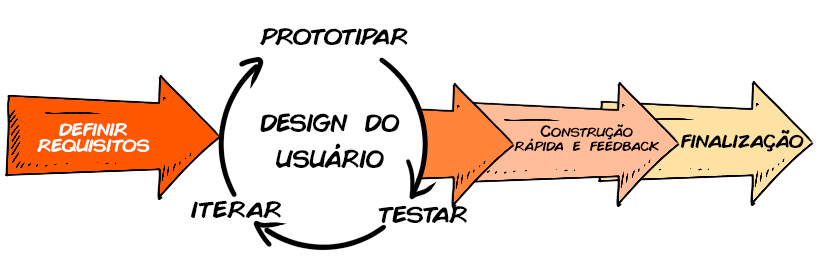
A development cycle in RAD projects begins with rapid and concise planning where requirements are discussed together with end users. During this process, initial and functional prototypes are built. These prototypes are adjusted and refined continuously. Since there is less formality in initial documentation and with a focus on rapid delivery of new testable versions, RAD can increase customer satisfaction and product effectiveness. Professionals capable of dealing with iterative cycles have a better chance of working in the software development market.
Among the requirements defined together with end users, we can mention:
- Goals
- Expectations
- Schedules
- Budget
Different authors define ways to organize cycles in a RAD project. Generally speaking, we can say that, within RAD, a cycle is composed of four phases:
- Define project requirements:
- In this phase, business needs, system requirements and their constraints are studied. The project only continues when users, managers and developers understand and agree with all requirements. Information is obtained regarding the functional requirements of the system gathered from various sources related to business, that is, the business model of the product under development is treated in terms of information flow, which is obtained from various business channels, such as interviews with system users and other sources of information that help in understanding the business that will be addressed.
- In the data modeling phase of the RAD methodology, the collected data is grouped into business objects. This phase is crucial for defining how data will be organized and used in the system, forming the basis for process modeling and subsequent application generation. Grouping data into business objects ensures that information is structured in a logical and efficient manner, allowing the final system to meet business needs accurately.
- All information obtained during the business modeling phase is analyzed to form sets of data objects essential for business. Through analysis, information is grouped so that it is useful for the company, such as determining which are the main entities that will be handled by the system. The quality of each data group is then examined and receives a precise description. Next, mapping is done that relates these groups to each other and what the meaning of these relationships is, as defined in the business modeling stage. Going a bit further, now one must identify and define the attributes of all data sets. The relationship between these data objects is also established and defined in detail of relevance to the business model.
- User Design:
- This phase is very interactive and involves creating prototypes to validate and refine how they correspond to system requirements, based on constant user feedback. All interfaces and flows identified in the first phase are created.
- Rapid Construction:
- In the rapid construction phase, application code is written, tested, and the prototype is converted into a functional model. This step can be repeated, if necessary, to incorporate new components and adjustments.
Since most problems identified by users and requested changes are handled in the design phase, developers can build a final model more agilely compared to traditional development methodologies.
- In the rapid construction phase, application code is written, tested, and the prototype is converted into a functional model. This step can be repeated, if necessary, to incorporate new components and adjustments.
- Product finalization / implementation:
- In this final phase of rapid development, developers address the technical debts that arose during prototyping, optimizing the implementation to make improvements in maintainability and product stabilization. Components then move to the production environment.
What is the difference between RAD and agile methodologies?
At first glance, one might think that RAD is just another agile methodology. Despite having significant similarities, agile methodologies are more comprehensive. We can cite the main differences as:
- RAD
- Focus on rapid development with frequent prototype deliveries.
- Work done with a single development team, with few members. The idea is to improve communication quality and rapid information transfer.
- User involvement throughout the entire process.
- Other methodologies
- Focus on delivering a functional product to the customer.
- Work done with larger teams, divided into different specializations. For example, in the agile model, there are teams with specific roles.
- User involvement only at the beginning and end of the project development cycle.
When to use the RAD methodology?
The RAD methodology is suitable for certain types of development, for example, when front-end system interactivity is a very important characteristic over back-end complexity (Berger & Beynon-Davies, 2009).
- When to apply?
- Small-scale projects
- Optimized teams of four to eight people
- Large-scale projects can also benefit from the RAD methodology as long as they are divided into smaller and more manageable projects.
- When not to apply?
- Real-time critical systems
- Systems with large infrastructure
- Functional requirements need to be specified in detail at the beginning of the project
- System needs integration with other existing systems
Conclusion
The RAD methodology proves to be an efficient and agile approach to software development, especially in flexible projects that need rapid deliveries with lots of user interactivity.
With its iterative and short cycles, continuous prototyping and constant feedback, RAD allows collaboration between users and developers to work together in creating functional and effective solutions that meet business needs.
However, like any methodology, RAD has limitations. It’s not advisable to use RAD in large-scale projects or critical systems because of its characteristics, such as the need for robust infrastructure or highly detailed requirements from the beginning. Even so, with qualified teams and stakeholder commitment, RAD can offer significant gains in productivity, innovation and customer satisfaction.
Therefore, when considering the RAD methodology for a project, it’s important to evaluate the context, available resources and expected objectives. If applied correctly, RAD not only accelerates development, but also transforms the way teams interact and deliver value.
RAD Methodology
Test your knowledge with this quiz!